Showing posts with label research. Show all posts

Wednesday, August 29, 2012

„Rollin' Justin“


The mobile humanoid roboter, named "Rollin' Justin", with its compliant controlled light weight arms and its two four finger hands is an ideal experimental platform for current research issues, such as the capability to carry out complex manipulation tasks.The newly developed mobile platform allows the long range autonomous operation of the system.The individually movable, spring born wheels match the special requirements of “Justin's” upper body during manipulation tasks. PMD sensors and cameras allow the 3D reconstruction of the robot's environment and therefore enable Justin to perform given tasks autonomously.
Click here for more information!

Tuesday, April 26, 2011

BOmobil

At Bochum the traffic goes green...

More than 10,000 employees in the automotive industry turn this city in the Ruhr region into one of the automotive locations in Germany. Industrial partners from the region Bochum - Bergisches Land participate in the development of the e-mobile which is to be used by companies as a van. It is planned to start with a small series of 50 to100 vehicles with a range of 150 km and Opel technology.

Among the participants is the university Bochum where the institute for electronic mobility deals with this project, the car manufacturer Opel and the Bochum initiative ruhrmobil-E. The project is supported by the Ministry of Commerce of North-Rhine Westphalia providing three million euros; another two million are contributed by industrial partners involved.

Using the BOmobil two people and max. 400 kg can jet through Bochum at a speed of up to 129 km/h for 150 kilometres.


Image source: University Bochum

More details:

http://www.jewo.de/en/~elektroauto

Monday, January 10, 2011

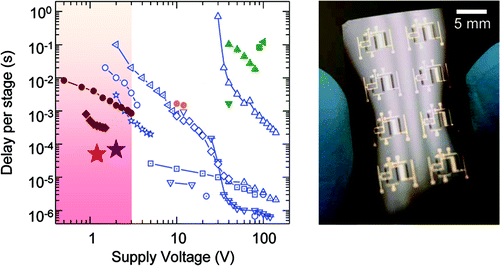
Record: The fastest printed circuits

American researchers have created flexible high-performance electronics by combining nanotubes and a new non-conductor.

The flexible electronics has a significantly higher switching speed than other circuits produced by means of printing processes. Furthermore the printed electronics ensures easy mass production, low prices and flexibility of the final product. "Printing processes permit all that; this field, however, has been dominated by organic semiconductors whose performance is comparably low" explains Mark Hersam, Professor of materials science and engineering.

The project manager Daniel Friesbie and Hersam combined only the very pure semiconducting nanotubes with the non-conducting gel and thus created circuits with record performances.


Image source http://pubs.acs.org


In their study the researchers report that flexible electronics resulted from the process that switch at frequencies of two kilohertz - at a voltage of 2.5 volts. "The colleagues have built components and circuits via printing processes whose speed at room temperature has never been reached so far" says John Rogers, professor of materials science at the University of Illinois at Urbana-Champaign. "These results are so exciting because they show that there are important and realistic applications for carbon nanotubes in electronics."

More details in the study:
http://pubs.acs.org/doi/abs/10.1021/nn100966s

Tuesday, October 5, 2010

Fraunhofer alliance generative manufacture

Fraunhofer Institut is also involved in the research of rapid prototyping.

The Fraunhofer alliance generative manufacture draws up consulting concepts and holistic research and development offers in the fields of materials, technology, engineering and methods. This includes feasibility analysis, strategic initial research, product development and process development.

Social, economic and ecological consequences are considered in the development of this generative method.


Image source: Fraunhofer ILT

Further information, only in German:

»»» www.rapidprototyping.fraunhofer.de

Tuesday, September 28, 2010

Robot telescope TRAPPIST

Observe comets and stars per remote control

A cooperative project of the Liège university and the Swiss Observatoire de Genève putthe TRAPPIST telescope into operation in June 2010. The new robot-driven telescope controlled from Liège has started its observation operation at the La Silla observatory of the ESO in Chile. The “TRAnsiting Planets and PlanetesImals Small Telescope”, TRAPPIST for short, is devoted to the study of planetary systems: On the one hand side it will analyse comets on their orbits around the sun and on the other hand it will prove the existence of planets outside our solar system (exoplanets) and determine their characteristics.


Image source: eso.org

Goal of the project

“The two objectives of our project are part of a growing interdisciplinary field of research: astrobiology which examines the origin and distribution of life in space", explains Michaël Gillon who is responsible for examining exoplanets at TRAPPIST.

The telescope is a light construction that is operated by a robot. The diameter of the mirror is 60 cm.

Here some more information about Trappist:

»»» http://arachnos.astro.ulg.ac.be/

Monday, August 23, 2010

Infinite space

Let us leave Star Trek behind because we will soon be able to do all that ourselves: exploring unknown space, measuring distances, following tracks, displaying directions of travel via flashing signals, recognising colours, measuring temperatures, avoiding hitting obstacles without any contact, distinguishing day and night, turning headlights on and off automatically, triggering alarm, .... all that - and much more - is possible using sensors of the ROBO TX Explorer – ’beam me up, Scotty’ will then only be a question of time...


»»» This way to the toy.

If you want to thrill your kids, this is certainly something for you: "Here you will learn more about modern and innovative materials and what you can do with electricity or what you'd rather not do. Always according to the motto - "Learn about technology while playing". OK, and if that does not draw anybody from the woodwork, then maybe this: "By the way: all big and small people celebrating their birthday on 04 July will get a sausage + a drink free of charge!"

»»» http://en.wikipedia.org/wiki/Fischertechnik

by the way:
fischertechnik is a product group of fischerwerke, the manufacturer of fastening systems. The grey nylon S-plugs are known all over the world.
When a creative employee assembled some kind of small vehicle from nylon gate remains in the year 1965, the company decided to send it as a nice Christmas present to all customers in the construction industry. The feedback was very positive and the people seemed to like it so much that there was a high demand for it. It was decided to set up a separate department. Since 1966 fischertechnik has been manufactured and sold in modest quantities.
There is no large advertising budget. The motto is "quality sells itself". The fischertechnik product group continues to yield only 10% of the total turnover


Goethe Universität in Frankfurt also 'plays' with the system:


»»» http://www.vsi.cs.uni-frankfurt.de/research/

Wednesday, August 11, 2010

Cord drive allows robot's hands to act vigorously


Image source: University of the Saarland

In future robots shall rescue earthquake victims from destroyed houses or help old-aged people at home. To make it possible that robots perform the tasks of human helpers they need hands that can grab heavy objects and can put them down again very carefully. Researchers at the university of the Saarland have now developed a cord drive for robotic hands that can transmit enormous powers in a simple and space-saving manner.

The catapult of the old Romans served as an example for the artificial muscles. The engineers presented this innovative miniature drive on the research stand at Hannover Messe from 17 to 24 April 2010. The project is a part of the EU project Dexmart. The project started two years ago with the goal to develop better robotic hands. Eight universities and research institutes in Germany, France, Italy and Great Britain participate. The university in Naples is responsible for the coordination.

»»» http://www.dexmart.eu/

Monday, July 12, 2010

Better late than never


If only I had this opportunity when I went to school... today I'll go to the 'Technology Day' and learn something about companies close to us. Last year the offer was really brilliant...

here's the review, unfortunately only in German:

»»» http://www.tag-der-technik.de/


Image source: VDI


Image source: VDI

or more details at:

»»» http://www.tvonline.vdi-bs.de/


Image source: VDI

Here's an international platform on the topic:

»»» http://www.scienceinschool.org/

It's about this:

Science in School aims to promote inspiring science teaching by encouraging communication between teachers, scientists, and everyone else involved in European science education.

Published quarterly, the journal addresses science teaching both across Europe and across disciplines: highlighting the best in teaching and cutting-edge research. It covers not only biology, physics and chemistry, but also maths, earth sciences, engineering and medicine, focusing on interdisciplinary work.

The contents include teaching materials; cutting-edge science; education projects; interviews with young scientists and inspiring teachers; European education news; reviews of books and other resources; and European events for teachers.

Science in School is published quarterly and is available free on this website; free print copies in English are distributed across Europe.

Tuesday, April 20, 2010

Space Elevator?


Image source: Wikimedia

A space elevator is a proposed structure designed to transport material from a celestial body's surface into space. Many variants have been proposed, all of which involve traveling along a fixed structure instead of using rocket powered space launch. The concept most often refers to a structure that reaches from the surface of the Earth on or near the Equator to geostationary orbit (GSO) and a counter-mass beyond...

»»» http://en.wikipedia.org/wiki/Space_elevator


The Vision

Climbers ascend a ribbon, 100,000 km long, strung between an anchor on Earth and a counterweight in space. Connecting Earth and space in a way never before possible, the space elevator will enable us to inexpensively and completely expand our society into space.

Beyond Earth, space elevators on the moon and Mars open new economic opportunities and expand humanity's reach ever so slightly into the solar system...

»»» http://www.spaceelevator.com/

Thursday, February 11, 2010

Simulation and animation of excavator and crane

Interesting simulations of construction machines using VRML models:


»»» Link: Project Information – Research Lab – NIST

VRML (Virtual Reality Modelling Language, pronounced vermal or by its initials, originally — before 1995 — known as the Virtual Reality Markup Language) is a standard file format for representing 3-dimensional (3D) interactive vector graphics, designed particularly with the World Wide Web in mind. It has been superseded by X3D (Source: Wikipedia).

But first you need to install a corresponding plug-in / player, e.g. here:

»»» www.octaga.com