
She is the daughter of a poet even though she could not see him for the first time on a portrait photo before she was 20 years old. Her mother played her part in this as well as in her natural-scientific interest - she was one of the few women who had studied geometry and astronomy. This mathematically interested mother brought her up befitting her social status in a conventional way; however, she ensured that she got a natural-scientific education - her tutor was a former Cambridge professor and the usual private tuition included the subjects mathematics and astronomy which was highly unusual for girls.
She developed an interest for machines when she was 18 years old. She visited technical exhibitions and attended scientific lectures. In the early 1830s she met the reputed mathematician Mary Somerville. Mary Somerville encouraged her to study mathematics and technology and introduced her to the scientific circles in London. Here she heard about Charles Babbage's idea of a new calculating machine, the difference engine, for the first time in 1834.
She got married at 19. Her husband wrote for her; nevertheless her marriage was quite unhappy - as she said herself - since there was only little time left for her two passions mathematics and music besides her motherly duties. To complicate matters further, access to libraries was forbidden for women. In 1840 she started correspondence with Augustus De Morgan, the first professor for mathematics at the University of London, so that she could at least continue her studies in this way.
After she translated an Italian article about Babbage's second big calculator project, the analytical engine, in 1842 and sent the text to Babbage, the latter encouraged her to study the engine in more detail and to add her own explanations. The comments tripled the length of the original article. Together they further worked out the programming basics of the analytical engine. Ada's suggestion to calculate the Bernouil figures is today considered to be first computer program.
'The analytical engine', she said, 'weaves algorithmic patterns just like the Jacquard loom weaves flowers and leaves.' Her mathematic brain was distinguished by her extraordinary imagination.
This cooperation found Babbage's interest but he declined any further cooperation.
Neither was it possible then to implement the theoretical findings into technology since at that time it was not possible to manufacture precision instruments such as today's EDP systems. However, her findings ensure that today's computer systems work: In 1979, more than 100 years after her death, a programming language was named after her.
Solution will be given in the next entry...
Showing posts with label machine. Show all posts
Showing posts with label machine. Show all posts
Monday, October 11, 2010

Monday, March 29, 2010
How actually do hydraulic cranes work?
Hydraulic cranes are very simple by design but can perform Herculean tasks that would otherwise seem impossible.
The hydraulic crane is based on a simple concept -- the transmission of forces from point to point through a fluid. Most hydraulic machines use some sort of incompressible fluid, a fluid that is at its maximum density….

for more information:
»»» http://science.howstuffworks.com/hydraulic-crane.htm
The hydraulic crane is based on a simple concept -- the transmission of forces from point to point through a fluid. Most hydraulic machines use some sort of incompressible fluid, a fluid that is at its maximum density….

for more information:
»»» http://science.howstuffworks.com/hydraulic-crane.htm
Saturday, March 13, 2010
I would sometimes like to have this
Do you think that would be possible?

Machine for studying several books at once, 1588.
A beautiful and ingenious machine, very useful and convenient for anyone who takes pleasure in study, especially those who are indisposed and tormented by gout. For with this machine a man can see and turn through a large number of books without moving from one spot.
»»» Source: www.ingenious.org.uk

Machine for studying several books at once, 1588.
A beautiful and ingenious machine, very useful and convenient for anyone who takes pleasure in study, especially those who are indisposed and tormented by gout. For with this machine a man can see and turn through a large number of books without moving from one spot.
»»» Source: www.ingenious.org.uk
Friday, February 12, 2010
Did you know?
...about the history of construction machines
The origin of these modern steel monsters dates back to medieval times. Men have always tried to use technology to dig the earth and reach the treasures deep under the surface. Gold, silver and especially ore for manufacture of tools and weapons were the most important raw materials to improve life and make it more comfortable. During industrialisation the multi-faceted coal complemented the list of important raw materials: a corner stone gaining more and more in importance at the beginning of the last century.
No sweet without sweat: these natural resources are hidden under a layer called overburden. This overburden must be removed to reach the actual raw material.
For illustration
Nowadays every person on earth uses 50 - 70 kg raw material per day. To bring this material to the surface 20 billion cbm of overburden must be loaded, transported and levelled. This job is done by small, large, gross and thin excavators.

Source: www.erstes-deutsches-baumaschinenmuseum.de
Around 1850 - birth of the excavator:
»»» detailed information can be found here
The origin of these modern steel monsters dates back to medieval times. Men have always tried to use technology to dig the earth and reach the treasures deep under the surface. Gold, silver and especially ore for manufacture of tools and weapons were the most important raw materials to improve life and make it more comfortable. During industrialisation the multi-faceted coal complemented the list of important raw materials: a corner stone gaining more and more in importance at the beginning of the last century.
No sweet without sweat: these natural resources are hidden under a layer called overburden. This overburden must be removed to reach the actual raw material.
For illustration
Nowadays every person on earth uses 50 - 70 kg raw material per day. To bring this material to the surface 20 billion cbm of overburden must be loaded, transported and levelled. This job is done by small, large, gross and thin excavators.
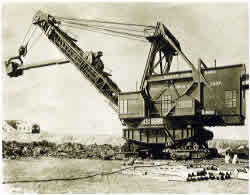
Source: www.erstes-deutsches-baumaschinenmuseum.de
Around 1850 - birth of the excavator:
»»» detailed information can be found here
Thursday, February 11, 2010
Simulation and animation of excavator and crane
Interesting simulations of construction machines using VRML models:

»»» Link: Project Information – Research Lab – NIST
VRML (Virtual Reality Modelling Language, pronounced vermal or by its initials, originally — before 1995 — known as the Virtual Reality Markup Language) is a standard file format for representing 3-dimensional (3D) interactive vector graphics, designed particularly with the World Wide Web in mind. It has been superseded by X3D (Source: Wikipedia).
But first you need to install a corresponding plug-in / player, e.g. here:
»»» www.octaga.com

»»» Link: Project Information – Research Lab – NIST
VRML (Virtual Reality Modelling Language, pronounced vermal or by its initials, originally — before 1995 — known as the Virtual Reality Markup Language) is a standard file format for representing 3-dimensional (3D) interactive vector graphics, designed particularly with the World Wide Web in mind. It has been superseded by X3D (Source: Wikipedia).
But first you need to install a corresponding plug-in / player, e.g. here:
»»» www.octaga.com
Subscribe to:
Posts (Atom)

