Hello memristor!
Memristor is a new word creation from memory and resistor because its characteristics are some kind of crossbreed between these two components. "It is a passive electric component in which the resistance is not constant but a function of the history. It is described as the fourth fundamental passive component, besides the resistor, the capacitor and the coil. In contrast to the other three components that came into existence in the early stages of electronic technology, the memristor could not be built before the year 2007."
http://de.wikipedia.org/wiki/Memristor
Leon Chua (University of California, Berkeley) described the memristor already in the year 1971 which at that time did not exist as a passive component. The first physical implementation of a thin-layer composite with such characteristics was reported in 2007.
In April 2008 researchers at the HP labs presented a relatively easy-structured layer composite of titanium dioxide with platinum electrodes as a memristor.
Its decisive advantage: A computer equipped with memristors could boot within fractions of a second because its state remains even when disconnected. "For years, we have made such tests", says HP Labs Senior Fellow Stan Williams. Today's PCs lose the contents of their working memories when switched off - the PC has to retrieve the requested information from the hard disk at each start.
The electronic components can even do a lot more: According to Williams, the memristors can also be linked to logic components to execute calculation operations and - in contrast to today's processors - they can also assume interim values and not only the values "0" and "1". They are possible because memristors do not have a constant but a variable resistor which can be continuously adjusted when the applied voltage is changed. The inventor is convinced that one day the hard disks, RAM and digital flash memories will be ready for the museum. These memory media are much too slow and physics restricts its miniaturisation. In already just a few years the HP developers will oust these memories from computers and mobile phones - and one day they will even make microprocessors redundant.
The idea of a memristor came to Leon Chua, today a professor of electrical engineering at the University of Berkeley who formulated the mathematical bases of electrical components in his doctorate thesis at the end of the 60ies. According to Chua's formulas there would have to be four of them: resistors, capacitances (capacitors), inductances (coils) and a crossbreed of a controllable resistor and memory function.
Monday, February 7, 2011
Monday, January 31, 2011
Porsche GT3 R Hybrid
The Porsche 911 GT3 R Hybrid has passed its most unusual task by now with flying colours in preparation for the Nürburgring 24 hour race on 15/16 May: AT&T Williams Formula 1 pilot Nico Hülkenberg tested the orange and white liveried racing 911 on the Nürburgring Nordschleife in the lead up to the third round of the VLN Long Distance Championship and was enthusiastic with many aspects: "Great car, fascinating technology and an incomparable track," concluded Hülkenberg.
»»» http://www.youtube.com/watch?hl=en&v=dSvWXFsuNAk
Labels:
gt3,
Hülkenberg,
hybrid,
nordschleife,
nuerburgring,
porsche
Monday, January 24, 2011
Lithium air batteries
Lithium air batteries can theoretically store three times as much energy per weight unit as a lithium ion battery. The current prototypes are, however, subject to many problems. Two of them could now be solved by a new, highly efficient catalyst.
By now omnipresent, there is no end in sight to the technical development of the lithium ion batteries. One of the latest ideas is a lithium air battery that owes its name to the fact that they generate current once the light metal lithium reacts with atmospheric oxygen. Referred to the weight it can store three times as much energy as the conventional lithium ion battery.
Sounds great but this energy store has been rather unpopular so far: poor efficiency, a short life cycle ( only few charge cycles), slow performance, current and water kill them and last but not least: lithium is highly reactive; it is possible that branches grow out of the electrodes which can cause short-circuits in the battery.
The MIT people have found a solution to at least two of the inconveniences: Thanks to a new catalyst they have succeeded in increasing the efficiency of the batteries to a new record value. This catalyst consists of nanoparticles of a gold-platinum alloy. Using it the prototype of the battery could release 77 percent of the energy stored.
It seems that the MIT people could have solved at least the efficiency problem with this catalyst. During discharge the lithium combines with atmospheric oxygen to lithium oxide and releases electrons. During charging both elements are separated. The new catalyst reinforces both reactions: The gold atoms help with oxidisation, the platinum atoms, however, support the separation of the oxygen. Thus less energy is wasted during charging and discharge.
Since the catalyst also alleviates the formation of lithium oxide clots that would otherwise clog the interior of the battery, it could also increase its life cycle. The future of the gold-platinum catalyst still remains to be seen because Jean-Marie Tarascon of the Université de Picardie Jules Verne is convinced of cheap manganese oxide since he has found out just recently that it has even better values than the compound of the MIT researcher, says Tarascon.
Excitement remains....
The paper: Lu, Y. et al., "Platinum-Gold Nanoparticles: A Highly Active Bifunctional Electrocatalyst for Rechargeable Lithium-Air Batteries", Journal of the American Chemical Society, 7.6.2010 (Abstract)
More information:
http://www.technologyreview.com/energy/25503/?a=f
By now omnipresent, there is no end in sight to the technical development of the lithium ion batteries. One of the latest ideas is a lithium air battery that owes its name to the fact that they generate current once the light metal lithium reacts with atmospheric oxygen. Referred to the weight it can store three times as much energy as the conventional lithium ion battery.
Sounds great but this energy store has been rather unpopular so far: poor efficiency, a short life cycle ( only few charge cycles), slow performance, current and water kill them and last but not least: lithium is highly reactive; it is possible that branches grow out of the electrodes which can cause short-circuits in the battery.
The MIT people have found a solution to at least two of the inconveniences: Thanks to a new catalyst they have succeeded in increasing the efficiency of the batteries to a new record value. This catalyst consists of nanoparticles of a gold-platinum alloy. Using it the prototype of the battery could release 77 percent of the energy stored.
It seems that the MIT people could have solved at least the efficiency problem with this catalyst. During discharge the lithium combines with atmospheric oxygen to lithium oxide and releases electrons. During charging both elements are separated. The new catalyst reinforces both reactions: The gold atoms help with oxidisation, the platinum atoms, however, support the separation of the oxygen. Thus less energy is wasted during charging and discharge.
Since the catalyst also alleviates the formation of lithium oxide clots that would otherwise clog the interior of the battery, it could also increase its life cycle. The future of the gold-platinum catalyst still remains to be seen because Jean-Marie Tarascon of the Université de Picardie Jules Verne is convinced of cheap manganese oxide since he has found out just recently that it has even better values than the compound of the MIT researcher, says Tarascon.
Excitement remains....
The paper: Lu, Y. et al., "Platinum-Gold Nanoparticles: A Highly Active Bifunctional Electrocatalyst for Rechargeable Lithium-Air Batteries", Journal of the American Chemical Society, 7.6.2010 (Abstract)
More information:
http://www.technologyreview.com/energy/25503/?a=f
Tuesday, January 18, 2011
Monday, January 10, 2011
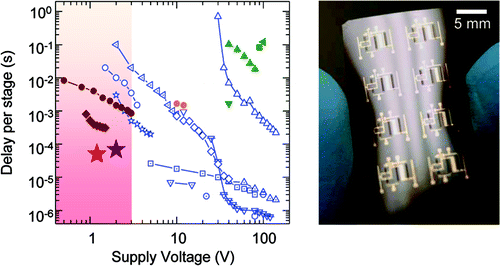
Record: The fastest printed circuits
American researchers have created flexible high-performance electronics by combining nanotubes and a new non-conductor.
The flexible electronics has a significantly higher switching speed than other circuits produced by means of printing processes. Furthermore the printed electronics ensures easy mass production, low prices and flexibility of the final product. "Printing processes permit all that; this field, however, has been dominated by organic semiconductors whose performance is comparably low" explains Mark Hersam, Professor of materials science and engineering.
The project manager Daniel Friesbie and Hersam combined only the very pure semiconducting nanotubes with the non-conducting gel and thus created circuits with record performances.

Image source http://pubs.acs.org
In their study the researchers report that flexible electronics resulted from the process that switch at frequencies of two kilohertz - at a voltage of 2.5 volts. "The colleagues have built components and circuits via printing processes whose speed at room temperature has never been reached so far" says John Rogers, professor of materials science at the University of Illinois at Urbana-Champaign. "These results are so exciting because they show that there are important and realistic applications for carbon nanotubes in electronics."
More details in the study:
http://pubs.acs.org/doi/abs/10.1021/nn100966s
The flexible electronics has a significantly higher switching speed than other circuits produced by means of printing processes. Furthermore the printed electronics ensures easy mass production, low prices and flexibility of the final product. "Printing processes permit all that; this field, however, has been dominated by organic semiconductors whose performance is comparably low" explains Mark Hersam, Professor of materials science and engineering.
The project manager Daniel Friesbie and Hersam combined only the very pure semiconducting nanotubes with the non-conducting gel and thus created circuits with record performances.

Image source http://pubs.acs.org
In their study the researchers report that flexible electronics resulted from the process that switch at frequencies of two kilohertz - at a voltage of 2.5 volts. "The colleagues have built components and circuits via printing processes whose speed at room temperature has never been reached so far" says John Rogers, professor of materials science at the University of Illinois at Urbana-Champaign. "These results are so exciting because they show that there are important and realistic applications for carbon nanotubes in electronics."
More details in the study:
http://pubs.acs.org/doi/abs/10.1021/nn100966s
Labels:
carbon,
circuits,
electronics,
Friesbie,
gel,
Hersam,
nanotubes,
non-conductor,
printed,
research
Monday, January 3, 2011
The first electric racing car
New at the Formula Student competition: electric mobility
The electric trend conquers curricula and competitions. One example: the Formula Student Competition 2010.

Image source: Formula Student Gallery
Formula Student Germany?
In a team students build a single seat formula racing car to participate in a worldwide competition. What is important is not speed but the overall package of construction, performance, financial planning and sales arguments.
The challenge of Formula Student is that in addition to their normal studies, students are to gain intensive experience in building and manufacturing as well as with the economic aspects of the automotive industry.

Image source: Formula Student Gallery
New discipline: electric mobility
24 teams intensively worked on solutions to an eco-friendly mobility. Finally eight of them managed to get into the final. Besides all other obstacles the teams have to overcome, scrutineering is hardest: "First of all, all electric drive elements have to be checked for safety. The complete high-voltage system is marked orange on the vehicle and every racing bolide is fitted with an e-stop," says Ulf Steinfurth, head of the scrutineering team.
"Team of TU Delft wins Formula Student Germany The winner of Formula Student Germany 2010 is the team of TU Delft. In the new electric vehicle discipline, Formula Student Electric, the greenteam of the Stuttgart University won the cup."

Image source: Formula Student Gallery
More information:
»»» http://www.formulastudentelectric.de/
The electric trend conquers curricula and competitions. One example: the Formula Student Competition 2010.

Image source: Formula Student Gallery
Formula Student Germany?
In a team students build a single seat formula racing car to participate in a worldwide competition. What is important is not speed but the overall package of construction, performance, financial planning and sales arguments.
The challenge of Formula Student is that in addition to their normal studies, students are to gain intensive experience in building and manufacturing as well as with the economic aspects of the automotive industry.

Image source: Formula Student Gallery
New discipline: electric mobility
24 teams intensively worked on solutions to an eco-friendly mobility. Finally eight of them managed to get into the final. Besides all other obstacles the teams have to overcome, scrutineering is hardest: "First of all, all electric drive elements have to be checked for safety. The complete high-voltage system is marked orange on the vehicle and every racing bolide is fitted with an e-stop," says Ulf Steinfurth, head of the scrutineering team.
"Team of TU Delft wins Formula Student Germany The winner of Formula Student Germany 2010 is the team of TU Delft. In the new electric vehicle discipline, Formula Student Electric, the greenteam of the Stuttgart University won the cup."

Image source: Formula Student Gallery
More information:
»»» http://www.formulastudentelectric.de/
Labels:
automotive,
Challenge,
competition,
eco-friendly,
electric,
formula,
greenteam,
mobility,
performance,
racing,
student
Monday, December 27, 2010
Myth Märklin

The oldest and biggest Märklin collection is presented in Oberhausen. The collection contains over ten thousand pre-war Märklin toys and a much higher number is from the period after 1945. 500 of these toys are presented in Oberhausen, many of them for the first time. The exhibits of the private museum are said to fill a football field, among them are prototypes and samples at an inestimable collector's value. However, the collector wants to stay incognito.

The collection is shown in Oberhausen for only one year. It will then disappear again into the private rooms of the collector who with expert's eye separated the wheat from the chaff.
So on to Oberhausen:
»»» www.mythos-maerklin.de
Monday, December 20, 2010
How are trees cut underwater?

Image source: Triton Logging Inc.
The robot "Sawfish" cuts trees underwater. When artificial lakes are flooded it often happens that trees lie under the water's surface. Here they perform no ecological function, nevertheless they are a valuable product.
The company "Triton Logging" invested 4 years and three million dollars in this project. The robot is controlled by a pilot. Eight board cameras help him to do his job in the dark and murky water. Every three hours the "Sawfish" weighing 3.5 tons is tested on the work platform. A small tug collects the trees at the surface.
About 100 trees are cut at the lake bottom every day. If all goes to the inventors' plans, the Sawfish will soon be used in many artificial lakes worldwide. The underwater trees are estimated to total approx. 200 million.

Image source: Triton Logging Inc.
»»» http://www.tritonlogging.com/
Labels:
mobile robot,
sawfish,
tree,
triton logging,
underwater
Monday, December 13, 2010
Electricity wins
On 13 July 2010 the R8 e-tron won the first "Silvrettra E-Auto Rally Montafon 2010", this is the R8 based Audi e-tron technology platform. Development manager Michael Dick, board member of AUDI AG, division technical development and factory driver Lucas Luhr drove the Audi e-tron electric sports car as winner across the finish line after 167.5 kilometres.

Image source: AUDI AG
Michael Dick is happy: "On the demanding race track of the Silvretta E-Auto Rally we showed with our R8 based e-tron technology platform that we are on the way to series maturity with our electric drive."
The rally
In the "Silvretta E-Auto Rally Montafon 2010" the 230 kW (313 hp) R8 e-tron technology platform had to demonstrate its ability. And that's what it did: The two seater won against 23 other electric cars and gained the victory with an advance of half a second in the overall standings.
Further information:
»»» http://www.egmcartech.com/~r8-e-tron-wins

Image source: AUDI AG
Michael Dick is happy: "On the demanding race track of the Silvretta E-Auto Rally we showed with our R8 based e-tron technology platform that we are on the way to series maturity with our electric drive."
The rally
In the "Silvretta E-Auto Rally Montafon 2010" the 230 kW (313 hp) R8 e-tron technology platform had to demonstrate its ability. And that's what it did: The two seater won against 23 other electric cars and gained the victory with an advance of half a second in the overall standings.
Further information:
»»» http://www.egmcartech.com/~r8-e-tron-wins
Labels:
audio,
e-tron,
electric,
montafon,
platform,
r8,
rallye,
silvretta,
sports car,
technology
Monday, December 6, 2010
First visible success
"Bosch increases speed for electromobility"
Bosch already has a programme for hybrid vehicles and electric drives. As first full hybrid vehicles with parallel technology of the Stuttgart-based company the new VW Touareg and Porsche Cayenne have been launched. Bosch invests € 400 million per year in hybrid and electric vehicle technologies. At present the first series production of electric motors and powerful electronics is set up in Hildesheim and Reutlingen. The large series production of Li-ion batteries from the Samsung-Bosch joint venture, SB LiMotive, is scheduled to start in 2011.

Image source: Robert Bosch GmbH
Link (content only in German):
»»» http://www.bosch-kraftfahrzeugtechnik.de/~electrification
Bosch already has a programme for hybrid vehicles and electric drives. As first full hybrid vehicles with parallel technology of the Stuttgart-based company the new VW Touareg and Porsche Cayenne have been launched. Bosch invests € 400 million per year in hybrid and electric vehicle technologies. At present the first series production of electric motors and powerful electronics is set up in Hildesheim and Reutlingen. The large series production of Li-ion batteries from the Samsung-Bosch joint venture, SB LiMotive, is scheduled to start in 2011.

Image source: Robert Bosch GmbH
Link (content only in German):
»»» http://www.bosch-kraftfahrzeugtechnik.de/~electrification
Labels:
batteries,
bosch,
cayenne,
cord drive,
electric,
electrification,
hybrid,
li-ion,
parallel,
porsche,
radio technology,
samsung,
touareg,
vehicle,
vw
Subscribe to:
Posts (Atom)