Monday, February 28, 2011

Once upon a time in a traffic jam

...directly behind a bus a smart engineer was struck by a brilliant idea: Why do buses in heavy-traffic areas not simply drive on stilts?


Image source: www.hsfuture.com

No sooner said than done: The south Chinese company Shenzhen Huashi Future Parking Equipment has found a really futuristic solution matching its own name: buses that simply bridge traffic jams and other obstacles on fence-like stilts.


Image source: www.hsfuture.com

Why making the simple complicated :)

»»» www.hsfuture.com/ehbus.html

Monday, February 21, 2011

Ecological power deluxe

The Porsche 918 Spyder drives frenzied activity into the gear of electric vehicle specialists such as Tesla Motors.


For too long hybrid cars had been reserved to manufacturers such as Toyota and Honda. German car manufacturers seemed to have been missing the trend. Now Porsche leaves all other cars in the dust with the 918 Spyder, currently the fastest hybrid vehicle in the world. Faster than most sports cars and more economical than any small car.


The elegant green ultra-fast car accelerates from a standstill to 100 km/h in just under 3.2 seconds, top speed of 320 km/h (198 mph) - without any emissions in the "E-drive"-mode because it is electrically driven. It can cover a distance of 25 km. If you want to jet through the city centre you should have 450,000 euros at hand. The new high-performance hybrids from Porsche illustrate one aspect, in spite of the utopian price: Even car producers who were quite hesitant to start with have got wind of the emission restrictions and specifications concerning low petrol consumption.


"In the innovative 918 Spyder concept study Porsche combines "intelligent performance" technology, motor sport high tech and also its classic modern shape language to a convincing statement."

The 8-cylinder engine with a cylinder capacity of 3.6 litres achieves 500 HP at max. 9,000 rpm. The rear drive works with a dual-clutch transmission with 7 gears. An electric motor between the engine and the transmission provides an additional torque. Electric motors on each of the two front wheels ensure 4-wheel drive. The three electric motors fed by lithium ion batteries with 5.1 kilowatt hours provide an additional 218 HP. According to simultaneous calculations made by Porsche the 918 Spyder is even a bit faster than the last super model, the Carrera GT. What remains to be said? Today ecological awareness is more elegant and somewhat more expensive than jute bags and batik shirts.


»»» www.porsche.com

Monday, February 14, 2011

Intelligent traffic lights


A new project has caused sensation in Lower Saxony and provides a new dimension of driving safety. Traffic lights fully equipped with brand-new sensors communicate with vehicles that also brim over with technology.

The only question is: When will infrastructure adapt to these developments so that investment into illustrious names such as stereo camera, Lidar sensor or a 77-gigahertz radar also pay for the conventional consumer?

What do you think?

Sorry, only in German:
www.innovatives.niedersachsen.de/~intelligenteste-ampel

And now we do not even have to take pains to test the tire pressure:

Sorry, only in German:
www.innovatives.niedersachsen.de/~der-intelligente-reifen

Monday, February 7, 2011

Bye bye transistor

Hello memristor!

Memristor is a new word creation from memory and resistor because its characteristics are some kind of crossbreed between these two components. "It is a passive electric component in which the resistance is not constant but a function of the history. It is described as the fourth fundamental passive component, besides the resistor, the capacitor and the coil. In contrast to the other three components that came into existence in the early stages of electronic technology, the memristor could not be built before the year 2007."

http://de.wikipedia.org/wiki/Memristor

Image source: Wikimedia, J. J. Yang, HP Labs.

Leon Chua (University of California, Berkeley) described the memristor already in the year 1971 which at that time did not exist as a passive component. The first physical implementation of a thin-layer composite with such characteristics was reported in 2007.

In April 2008 researchers at the HP labs presented a relatively easy-structured layer composite of titanium dioxide with platinum electrodes as a memristor.

Its decisive advantage: A computer equipped with memristors could boot within fractions of a second because its state remains even when disconnected. "For years, we have made such tests", says HP Labs Senior Fellow Stan Williams. Today's PCs lose the contents of their working memories when switched off - the PC has to retrieve the requested information from the hard disk at each start.

The electronic components can even do a lot more: According to Williams, the memristors can also be linked to logic components to execute calculation operations and - in contrast to today's processors - they can also assume interim values and not only the values "0" and "1". They are possible because memristors do not have a constant but a variable resistor which can be continuously adjusted when the applied voltage is changed. The inventor is convinced that one day the hard disks, RAM and digital flash memories will be ready for the museum. These memory media are much too slow and physics restricts its miniaturisation. In already just a few years the HP developers will oust these memories from computers and mobile phones - and one day they will even make microprocessors redundant.

The idea of a memristor came to Leon Chua, today a professor of electrical engineering at the University of Berkeley who formulated the mathematical bases of electrical components in his doctorate thesis at the end of the 60ies. According to Chua's formulas there would have to be four of them: resistors, capacitances (capacitors), inductances (coils) and a crossbreed of a controllable resistor and memory function.

Monday, January 31, 2011

Porsche GT3 R Hybrid

The Porsche 911 GT3 R Hybrid has passed its most unusual task by now with flying colours in preparation for the Nürburgring 24 hour race on 15/16 May: AT&T Williams Formula 1 pilot Nico Hülkenberg tested the orange and white liveried racing 911 on the Nürburgring Nordschleife in the lead up to the third round of the VLN Long Distance Championship and was enthusiastic with many aspects: "Great car, fascinating technology and an incomparable track," concluded Hülkenberg.


»»» http://www.youtube.com/watch?hl=en&v=dSvWXFsuNAk

Monday, January 24, 2011

Lithium air batteries

Lithium air batteries can theoretically store three times as much energy per weight unit as a lithium ion battery. The current prototypes are, however, subject to many problems. Two of them could now be solved by a new, highly efficient catalyst.

By now omnipresent, there is no end in sight to the technical development of the lithium ion batteries. One of the latest ideas is a lithium air battery that owes its name to the fact that they generate current once the light metal lithium reacts with atmospheric oxygen. Referred to the weight it can store three times as much energy as the conventional lithium ion battery.

Sounds great but this energy store has been rather unpopular so far: poor efficiency, a short life cycle ( only few charge cycles), slow performance, current and water kill them and last but not least: lithium is highly reactive; it is possible that branches grow out of the electrodes which can cause short-circuits in the battery.

The MIT people have found a solution to at least two of the inconveniences: Thanks to a new catalyst they have succeeded in increasing the efficiency of the batteries to a new record value. This catalyst consists of nanoparticles of a gold-platinum alloy. Using it the prototype of the battery could release 77 percent of the energy stored.

Image source: Yi-Chun Lu

It seems that the MIT people could have solved at least the efficiency problem with this catalyst. During discharge the lithium combines with atmospheric oxygen to lithium oxide and releases electrons. During charging both elements are separated. The new catalyst reinforces both reactions: The gold atoms help with oxidisation, the platinum atoms, however, support the separation of the oxygen. Thus less energy is wasted during charging and discharge.

Since the catalyst also alleviates the formation of lithium oxide clots that would otherwise clog the interior of the battery, it could also increase its life cycle. The future of the gold-platinum catalyst still remains to be seen because Jean-Marie Tarascon of the Université de Picardie Jules Verne is convinced of cheap manganese oxide since he has found out just recently that it has even better values than the compound of the MIT researcher, says Tarascon.

Excitement remains....

The paper: Lu, Y. et al., "Platinum-Gold Nanoparticles: A Highly Active Bifunctional Electrocatalyst for Rechargeable Lithium-Air Batteries", Journal of the American Chemical Society, 7.6.2010 (Abstract)

More information:
http://www.technologyreview.com/energy/25503/?a=f

Monday, January 10, 2011

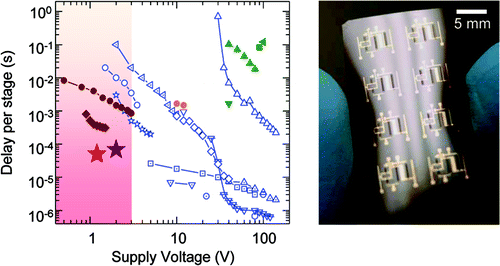
Record: The fastest printed circuits

American researchers have created flexible high-performance electronics by combining nanotubes and a new non-conductor.

The flexible electronics has a significantly higher switching speed than other circuits produced by means of printing processes. Furthermore the printed electronics ensures easy mass production, low prices and flexibility of the final product. "Printing processes permit all that; this field, however, has been dominated by organic semiconductors whose performance is comparably low" explains Mark Hersam, Professor of materials science and engineering.

The project manager Daniel Friesbie and Hersam combined only the very pure semiconducting nanotubes with the non-conducting gel and thus created circuits with record performances.


Image source http://pubs.acs.org


In their study the researchers report that flexible electronics resulted from the process that switch at frequencies of two kilohertz - at a voltage of 2.5 volts. "The colleagues have built components and circuits via printing processes whose speed at room temperature has never been reached so far" says John Rogers, professor of materials science at the University of Illinois at Urbana-Champaign. "These results are so exciting because they show that there are important and realistic applications for carbon nanotubes in electronics."

More details in the study:
http://pubs.acs.org/doi/abs/10.1021/nn100966s

Monday, January 3, 2011

The first electric racing car

New at the Formula Student competition: electric mobility

The electric trend conquers curricula and competitions. One example: the Formula Student Competition 2010.


Image source: Formula Student Gallery

Formula Student Germany?
In a team students build a single seat formula racing car to participate in a worldwide competition. What is important is not speed but the overall package of construction, performance, financial planning and sales arguments.

The challenge of Formula Student is that in addition to their normal studies, students are to gain intensive experience in building and manufacturing as well as with the economic aspects of the automotive industry.


Image source: Formula Student Gallery

New discipline: electric mobility

24 teams intensively worked on solutions to an eco-friendly mobility. Finally eight of them managed to get into the final. Besides all other obstacles the teams have to overcome, scrutineering is hardest: "First of all, all electric drive elements have to be checked for safety. The complete high-voltage system is marked orange on the vehicle and every racing bolide is fitted with an e-stop," says Ulf Steinfurth, head of the scrutineering team.

"Team of TU Delft wins Formula Student Germany The winner of Formula Student Germany 2010 is the team of TU Delft. In the new electric vehicle discipline, Formula Student Electric, the greenteam of the Stuttgart University won the cup."


Image source: Formula Student Gallery

More information:
»»» http://www.formulastudentelectric.de/

Monday, December 27, 2010

Myth Märklin


The oldest and biggest Märklin collection is presented in Oberhausen. The collection contains over ten thousand pre-war Märklin toys and a much higher number is from the period after 1945. 500 of these toys are presented in Oberhausen, many of them for the first time. The exhibits of the private museum are said to fill a football field, among them are prototypes and samples at an inestimable collector's value. However, the collector wants to stay incognito.


The collection is shown in Oberhausen for only one year. It will then disappear again into the private rooms of the collector who with expert's eye separated the wheat from the chaff.

So on to Oberhausen:
»»» www.mythos-maerklin.de