Monday, November 28, 2011

On 18 August 1896 Gottlieb Daimler ...

... proudly presented the first truck worldwide.

After his studies of Mechanical Engineering the son of a master baker got to know the designer Wilhelm Maybach in his first job in a mechanical engineering company. This lifelong friendship and cooperation not only resulted in the first benzene-driven combustion engine, the first motorbike (1885), the first engine-driven carriage (1886) or engines for boats, locomotives and airships (1887/1888) but also in the company Daimler-Motoren-Gesellschaft founded in 1890.

Finally on 18 August 1896 his group presented the first motorised truck of the world, the "Phönix".


A two-cylinder engine with a cylinder capacity of 1.06 litres achieved a power of 4 PS and a maximum speed of 16 km/h. In the open and on iron wheels the driver could go for about 200 kilometers. On 1 October 1896 Daimler-Motorengesellschaft delivered the first truck to London.

Further information:
http://en.wikipedia.org/wiki/Gottlieb_Daimler

Monday, November 21, 2011

Who was trained ...

... to become a gunsmith before constructing the first truck?

Monday, November 14, 2011

A giant on Australia's roads


The "road train" is the longest road-driven truck of its kind (it really travels on "normal" roads).

It is 53.5 metres long and pulls up to 4 trailers. By comparison, the longest trucks in Germany measure 18.75 metres.

Further information:
http://en.wikipedia.org/wiki/Road_train

Wednesday, November 9, 2011

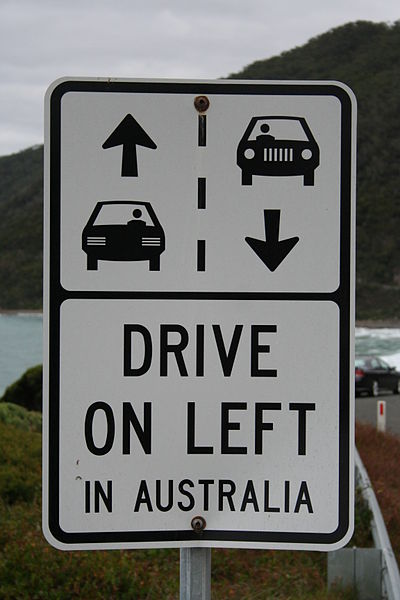
Why are the steering wheels of English cars on the right-hand side?

The term left-hand traffic refers to road traffic which, in contrast to right-hand traffic, keeps to the left side of the road seen from the driver's perspective. Left-hand traffic countries are mainly those formerly governed by Britain. There are many theories and explanations for this way of traffic routing.

For example, it is assumed that right- or left-handed people determined the respective standards. Some believe, among other things, that this way of driving, which seems unusual to us German right-hand drivers, originates from the days when we travelled the roads in horse-drawn carriages. In those days, the reins were held on the left, right or in the middle or the vehicle was steered with the left or right hand.

Although this may seem arbitrary, there is no need to worry; a change from right-hand to left-hand traffic is very complex and, therefore no longer feasible.


Further information:
http://en.wikipedia.org/wiki/Right-_and_left-hand_traffic

Wednesday, November 2, 2011

When was the first chariot built?

A full-scale model of a chariot in a grave in Crete can be dated back to 1 900 B.C. Chariots were already used in Central Asia.

You will find further information here:

http://en.wikipedia.org/wiki/Chariot

Friday, October 28, 2011

High lift rescue vehicle

High lift rescue vehicles save human life even at great height.

The fire brigades have high lift rescue vehicles to save people in dangerous situations at great height. They thus secure the second escape route for trapped persons as required in building laws.

High lift rescue vehicles are special fire engines used to rescue persons, animals and goods at great height. For this purpose a turntable ladder is used. A "turntable ladder" is the movable part of a high lift rescue vehicle which is located above the truck chassis.

Have a look here:
German Youtube Video


Monday, October 24, 2011

On 26 June 1974 ...

... the cashier Sharon Buchanan scanned a ten pack of chewing gum according to the UPC standard (Universal Product Code) in a supermarket in Troy, Ohio.

The code had, however, already been developed and patented at the end of the 40s by two students of the Drexel Institute of Technology in Philadelphia: Joseph Woodland and Bernard Silver.


Further information:
http://en.wikipedia.org/wiki/Barcode

Monday, October 17, 2011

When and where was the first bar code scanned...

... thus changing the world of logistics forever?

Monday, October 10, 2011

Shell Eco-marathon


The Shell Eco-marathon challenges high school and college student teams from around the world to design, build and test energy efficient vehicles. With annual events in the Americas, Europe and Asia, the winners are the teams that go the farthest distance using the least amount of energy.

More information:
http://www.shell.com/home/content/ecomarathon/

Thursday, October 6, 2011

Trailing Suction Hopper Dredger?

Is it a hopping dredger or is it named after its inventor?

No, it is a swimming dredger used to excavate easily removable sediments such as sand. The self-driven cargo hold suction dredger removes solid material from the bottom of waters through trailing heads and pumps it into the hopper tanks in the ship through a suction pipe. Among others, the hopper dredger is used to deepen ship channels.

The biggest hopper dredger so far is the Vasco da Gama, built in 2000. It was also used for the construction of the Palm Islands of Dubai.

http://www.shipcad.com/en/03_ref_vdg.php


Image source: Wikimedia "Crestway"